
What is OSINT?
Any particulars or facts that can be discovered publicly, mainly through the internet devoid of any copyright or privacy laws is acronymized as OSINT i.e. Open Source Intelligence. More simply, it cites all the information which is open for public utilization. Say, it online sources or offline sources, free content or paid ones like research papers, journals, etc. these all constitute OSINT resources. In general, OSINT provides a framework of tools and techniques that we can use to gather information about our target using publicly available resources.
Initially, media channels, newspapers, FMs, televisions, etc. were the major sources considered for open-source information bunching, while today these sources are categorized as follow:
Internet - covering blogs, websites, digital files, webcams, deep web, darknet resources, IP addresses, etc.
Traditional media channels – TV, FMs, newspapers, periodic, and others in the genre.
Academic publications – Research papers, journals, books, etc.
Corporate papers – including company and employee profiles and related documents
Geospatial information – online maps, geo-location information linked to social media posts, transport tracking, and more.
Why is OSINT important?
Today, OSINT stands out as important in the all-source intelligence process due to numeral reasons. Like present external threats are a lot varied and terrestrially diffused and thus comprehending social, economic, cultural information of particular region is crucial. From producing all this information to providing a base for analyzing rumored potential terror attacks, open-source play a far-reaching role at this junction. Even open sources comfort in defending various methods involved in intelligence judgment, ethical hacking, penetration testing, and storing or monitoring history.
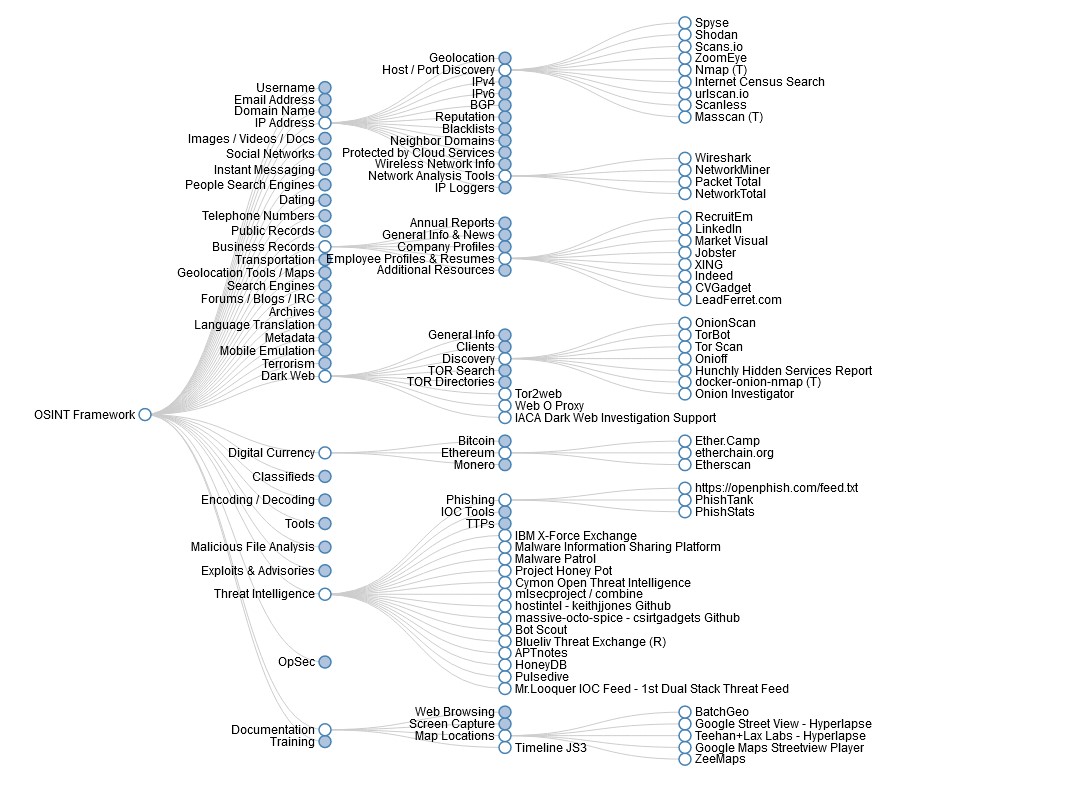
Open Source Intelligence Techniques
Every entity has two sides. Agree? If open source is so easily accessible to intelligence scientists on the similar ground it’s obtainable to malicious actors. The latter can use this boon to exploit weaknesses in target networks. Taking it as a scope of improvement open sources thus helps to point out and mend the fragilities in your firm’s network.
Reaching out to the techniques for collecting open-source information, it can be done either passively or actively.
Passive Collection: It includes availing threat intelligence platforms (TIPs) where various threat feeds are stacked to a single location. Though information overloading is a major issue here, solutions like Recorded Future helps to pull it down to major extents by the use of AI, ML, etc.
Active Collection: It is a dynamic approach to locate public data. Here analysts need to have basic credentials, such as emails and usernames to first gain access to the sites that hold valuable data.
Open Source Intelligence Tools
Finally, let’s jump to the tools commonly used for the collection of open-source information. The very first amongst the list is the search engines like Google, Bing, and others in the catalog. While for advanced search options Google dork queries are one of the preferred ways. Moreover, Wappalyzer is used to determine which technologies are used on a website, and then the results are combined with either Sploitus or the National Vulnerability Database to check for any vulnerability that exists. Again for a more progressive search as mentioned earlier Recorded Future gives ease to it. Apart from these some of the top tools include –
Maltigo
Mitaka
SpiderFoot
Spyse
BuiltWith
Intelligence X
DarkSearch.io
Grep.app
Recon-ng
theHarvester
Shodan
Metagoofil
Searchcode
Babel X
In the end,
Knowing what you need to accomplish,
Setting objectives consequently,
Spotting out the appropriate tools for the same,
Will contribute towards saving your time as well as provide better results for your OSINT search.
For more information visit us on: www.nexixsecuritylabs.com
To schedule an audit you can contact us on: contact@nexixsecuritylabs.com
Your Security | Our Concern